
The First 48 Hours: Why Water Damage Response Time Decides Your Repair Bill
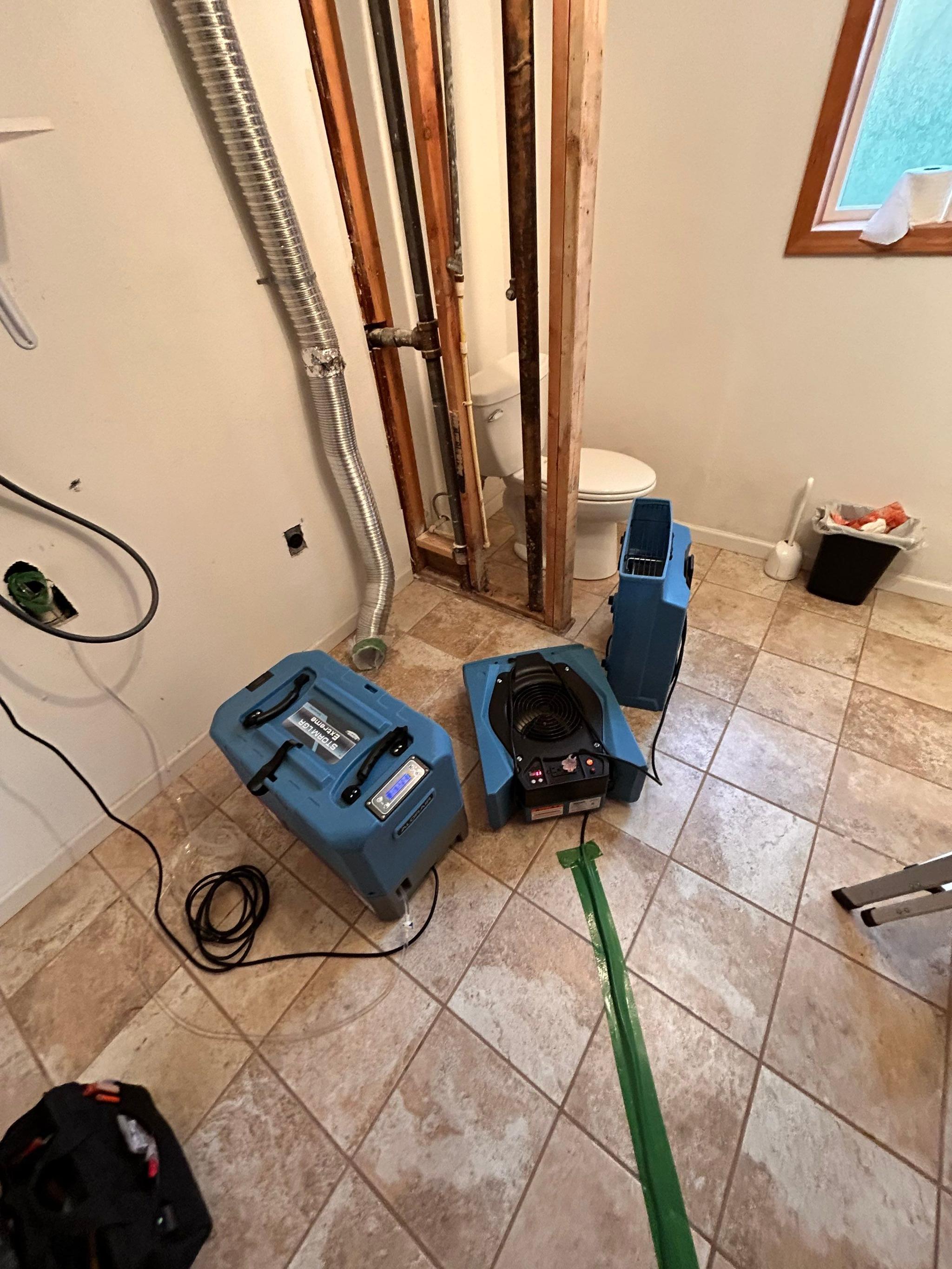
Water damage does not get worse gradually. It escalates in steps, and each step multiplies the scope of the repair. A burst supply line caught in three hours is a drying job. The same line caught in three days is a demolition and rebuild.
Here is what is actually happening inside the structure while you wait.
Hours 0 to 24: migration
Water moves faster through a building than most people expect, and it moves in directions that are not obvious. It wicks up drywall against gravity, travels along the underside of subfloor, follows electrical and plumbing penetrations between floors, and pools in wall cavities where nothing is visible from the room.
Within the first day, carpet pad is saturated, drywall has wicked moisture 12 to 24 inches above the water line, and hardwood has begun to cup. Insulation in affected cavities has lost most of its R-value and holds water against the framing.
This is the window where the outcome is decided. Extraction and airflow started inside 24 hours will usually save the flooring, the drywall below the wick line, and the subfloor.
Hours 24 to 48: biological growth
Mold spores are present in every building in Missouri. They are inert until they have moisture and a cellulose food source, which is exactly what wet drywall, wood, and paper-faced insulation provide. Colonization begins in 24 to 48 hours under normal indoor temperatures.
Once mold is established, the job changes character entirely. It now requires containment, negative air pressure, HEPA filtration, and removal of colonized material rather than drying it in place. Occupants with asthma or compromised immunity may need to leave the property. The cost typically doubles.
Water category also degrades on this clock. Category 1 clean water from a supply line becomes Category 2 grey water as it picks up contaminants from flooring, dust, and building materials. Category 2 becomes Category 3 — the category that requires the same handling as sewage — after roughly another 48 hours.
Day 3 and beyond: structural and claim consequences
Past 72 hours, subfloor delaminates, engineered wood swells irreversibly, and framing moisture content stays high enough to support ongoing growth. Cabinet boxes fail at the base. Odor becomes established in porous contents.
There is a claims consequence too, and it catches people out. Nearly every homeowner's policy contains a duty to mitigate — an obligation to take reasonable steps to prevent further damage after a loss. Documented delay gives a carrier grounds to deny the portion of the damage that occurred because of the wait, not because of the original event.
In practice this means calling a restoration company promptly is not just cheaper, it protects the claim itself.
What to do before we arrive
Shut off the water at the source if you can reach the valve safely. Cut power to affected rooms at the breaker if water is near outlets or the panel — do not walk into standing water to reach a switch.
Photograph everything before you move anything. Wide shots of each room, then close-ups of the source and the damage. This is the documentation your adjuster will rely on, and it cannot be recreated later.
Lift what you can: move furniture off wet carpet, put foil or wood blocks under legs to stop finish bleed, and get contents off the floor. Do not run a household vacuum on standing water and do not assume box fans are drying anything — moving humid air around a closed room without dehumidification just redistributes moisture.
Then call. Fast Restoration dispatches 24 hours a day across St. Charles County and West St. Louis County, and our crews target a 60-minute arrival. The equipment matters, but the hour you call matters more.
Need Professional Restoration Services?
Fast Restoration provides 24/7 emergency response for water damage, mold remediation, and property restoration throughout St. Charles County, Missouri.