Remediation vs Restoration: What St. Charles County Homeowners Need to Know
If you have just filed a claim, you have probably seen both words on the same estimate — remediation on one line, restoration on another — and wondered whether you are being billed twice for the same work. You are not. They are two distinct phases of the same job, they use different crews and different equipment, and insurers treat them differently.
Getting the distinction straight matters, because it determines what happens in the first 72 hours, what your adjuster will authorize without a second inspection, and whether the repair holds up a year from now.
Remediation: removing the hazard
Remediation is the emergency phase. Its only goal is to stop the damage from spreading and make the building safe to occupy and work in. Nothing is rebuilt during remediation — in fact, remediation usually makes a property look worse before it looks better, because it involves removing saturated and contaminated material.
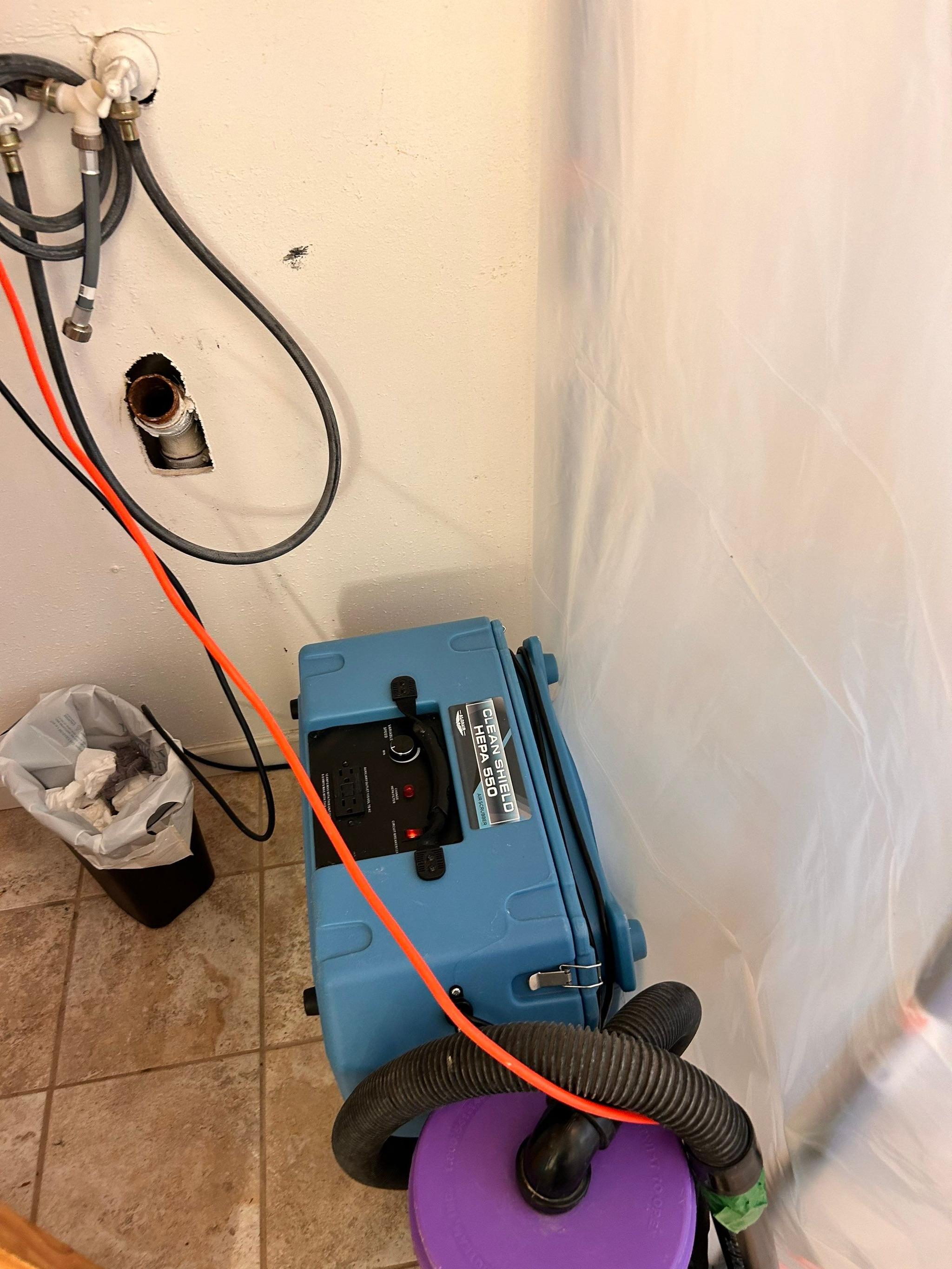
On a typical water loss in St. Charles County, remediation means extracting standing water, pulling wet carpet and pad, cutting out drywall to above the visible water line, removing saturated insulation, setting containment where contaminated water is involved, and running dehumidifiers and air movers until the structure meets dry standard. On a mold job it means HEPA filtration, negative-air containment, and physical removal of colonized material — mold is never simply sprayed and left in place.
Remediation is time-critical in a way restoration is not. Category 1 clean water degrades to Category 2 within roughly 48 hours and to Category 3 shortly after. Mold colonizes damp cellulose in 24 to 48 hours. Every hour of delay moves the job into a more expensive category and a broader scope, which is why our crews are dispatched around the clock rather than scheduled.
Restoration: putting the property back
Restoration is the rebuild. It begins only after the affected materials have been removed and moisture readings confirm the structure is dry — hanging new drywall over a wet stud cavity is the single most common way a restoration job fails and has to be redone at someone's expense.
Restoration covers drywall replacement and finishing, texture matching, painting, trim and baseboard, flooring, cabinetry, and any structural repair the loss required. On larger losses it extends to full reconstruction of finished basements, kitchens, and bathrooms.
The quality bar for restoration is that the repair should be invisible. Matching a 1970s ceiling texture in a Kirkwood ranch or a specific hardwood run in a Historic Main Street property is skilled work, and it is where the difference between contractors actually shows.
Why insurers treat them differently
Most policies authorize emergency mitigation without a formal approval step, because the carrier's own interest is in stopping the loss from growing. That is why we can begin extraction and drying the night you call, before an adjuster has seen the property.
Reconstruction generally requires a written scope and adjuster sign-off. This is the stage where documentation earns its keep: moisture logs, daily readings, photographs of every affected assembly, and a line-item scope written to the carrier's own estimating standard. Losses get underpaid far more often because the documentation was thin than because the carrier was unreasonable.
One practical consequence: if a contractor offers to skip drying and go straight to rebuild to save you time, decline. The carrier will not pay twice when the moisture reappears, and you will be the one holding the second invoice.
What this means for your job
Ask any company you are considering whether they perform both phases. Many do remediation only, hand you a dry but gutted room, and leave you to find a general contractor months later — at which point the claim has often closed.
Fast Restoration performs both. The crew that documents the loss is the crew that rebuilds it, which means nothing is lost in the handoff between mitigation and reconstruction, and there is one point of accountability for the finished result.
Need Professional Restoration Services?
Fast Restoration provides 24/7 emergency response for water damage, mold remediation, and property restoration throughout St. Charles County, Missouri.